What the PT-30 does in an ELD system
The PT-30 connects to the vehicle's diagnostic port and reads engine data from the ECM. It does not run the HOS rules itself. It supplies vehicle data to the driver mobile application, and the app implements HOS calculations, duty status management and log synchronization.
Typical information retrieved, subject to what the vehicle ECM provides: engine hours, vehicle speed, odometer or distance, engine operation, and vehicle identification information.
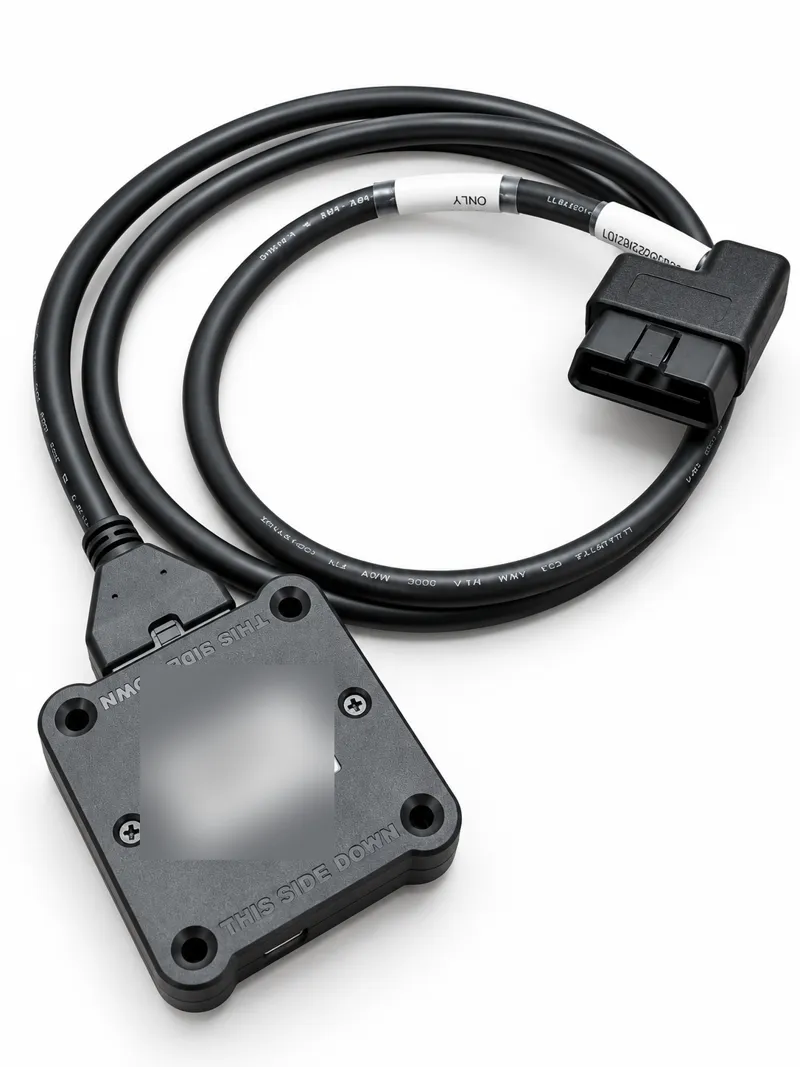
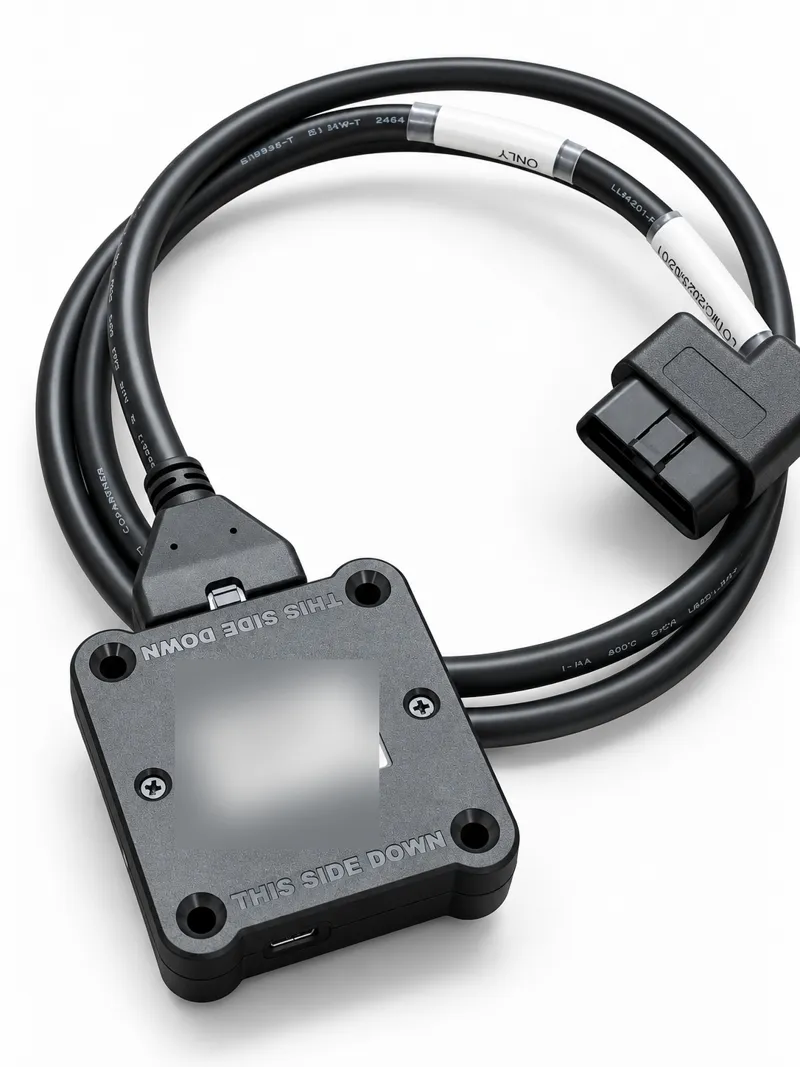
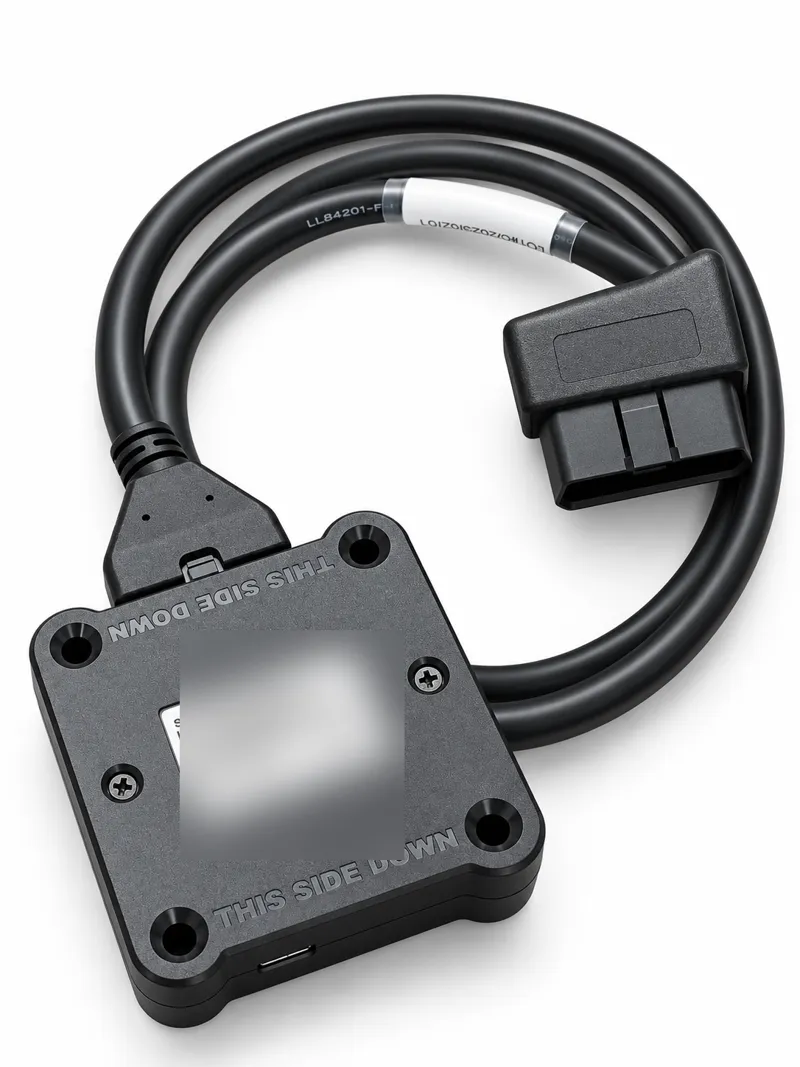
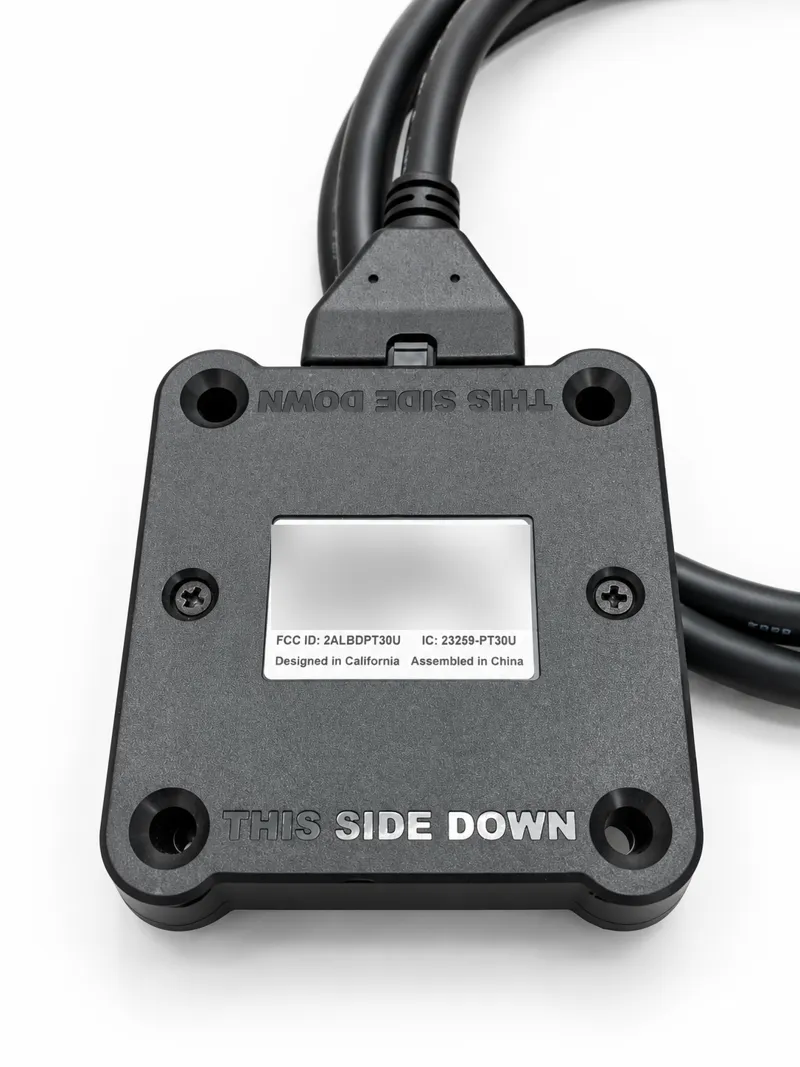
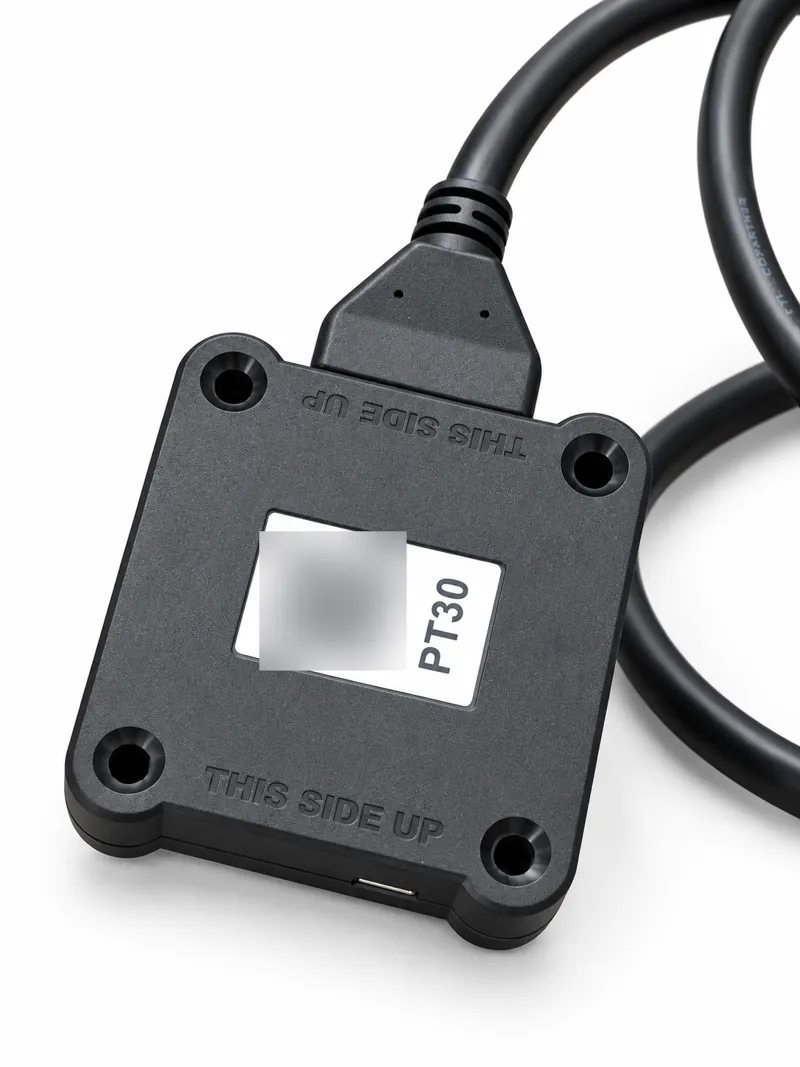
The PT-30 unit and its OBD-II cable. Serial and identification labels are blurred.
Vehicle connection and protocols
- Diagnostic port cables: 9-pin Deutsch, 6-pin or 16-pin OBD-II, as applicable to the vehicle.
- Supported protocols: SAE J1939, SAE J1708/J1587 and OBD-II CAN.
- Hardware interface: 10-pin Molex Micro-Fit 3.0, as indicated in the published product summary.
Connectivity: Bluetooth, GPS and no built-in modem
| Feature | Details |
|---|---|
| Bluetooth | Bluetooth Low Energy (BLE); Bluetooth 4.2 listed in the product summary |
| GPS | Built-in GPS receiver and antenna |
| 4G / LTE or SIM | No integrated cellular modem listed for the standard PT-30 |
| Mobile integration | Android and iOS SDK / integration support |
| Cloud connectivity | Typically through the connected phone's internet connection (cellular or Wi-Fi) |
Typical data flow
Truck ECM / diagnostic port → PT-30 (vehicle data, GPS, event storage) → Bluetooth LE → Android or iOS ELD app → mobile internet → cloud server and fleet management dashboard.
Power, size and hardware
| Specification | Published detail |
|---|---|
| Input voltage | 8 to 28 V DC |
| Power source | Vehicle diagnostic connection |
| Dimensions | 76 × 71 × 20 mm |
| Operating temperature | -30°C to +65°C |
| Event storage | Over 50,000 events |
| Accelerometer | 3-axis |
| CAN speed | 250 / 500 kbps |
| Backup battery | Optional rechargeable battery mentioned for tamper detection |
Verify before you rely on these numbers. The figures above come from an older PT-30 product summary (version 1.7, marked preliminary). Check the exact hardware revision and the manufacturer's current documentation before treating any of them as guaranteed specifications.
How Inurum uses the PT-30 with its own ELD
The PT-30 is not an Inurum device. It is a third-party device that is already widely used with ELD systems in the USA. Inurum has integrated the PT-30 into its own ELD software, and data from the device is flowing into our system.
Through the integration we receive the data an ELD needs, including GPS latitude and longitude, vehicle speed and engine hours. The data is encrypted and decrypted as part of our integration between the device, the driver app and the cloud.
This is an integration of a third-party device with our software. It is not a statement that the complete solution is FMCSA certified or registered (see the next section). For how we work with ELD partners, see our white-label ELD software page.
The PT-30 alone does not make an ELD FMCSA compliant
PT-30 hardware integration by itself does not establish full FMCSA ELD compliance. The complete solution depends on hardware and firmware behavior, the ELD app, HOS rules, data recording, malfunction and diagnostic management, the data transfer implementation, and the required validation and testing.
Evaluating an alternative to the PT-30
Fleet technology companies sometimes look for alternative ELD hardware. Any alternative should be evaluated for vehicle protocol coverage, Bluetooth and SDK interoperability, GPS accuracy, operating voltage, firmware reliability, offline event handling and integration with the ELD application.
Wording matters here. While compatibility has not been verified, call it an alternative ELD hardware solution with J1939, J1708/J1587 and OBD-II support. Only after compatibility is verified should it be called PT-30-compatible hardware.
Inurum designed and built an ELD hardware unit for a client as an alternative to the PT-30 device used in the US market. Hardware certification is not part of that work and is completed by the partner.
Frequently asked questions
What is the PT-30 in an ELD system?
The PT-30 is a vehicle-connected ELD interface. It plugs into the vehicle diagnostic port, reads engine data such as engine hours, speed and odometer, records events with GPS, and passes them over Bluetooth Low Energy to a driver app on an Android or iOS phone. The app does the Hours of Service logic.
Does the PT-30 have a built-in 4G modem or SIM?
The standard PT-30 listed in the published product summary has no integrated cellular modem. Cloud connectivity usually comes through the connected phone's mobile data or Wi-Fi.
Which vehicle protocols does the PT-30 support?
SAE J1939, SAE J1708/J1587 and OBD-II CAN, with 9-pin Deutsch, 6-pin and 16-pin OBD-II cable configurations as applicable. What data you actually get depends on the vehicle ECM.
Does using a PT-30 make an ELD FMCSA compliant?
No. Hardware integration alone does not establish FMCSA ELD compliance. The full solution also depends on firmware behavior, the ELD app, HOS rules, data recording, malfunction and diagnostic management, data transfer and validation testing.
Does Inurum support the PT-30 in its ELD?
Yes. Inurum has integrated the PT-30, a third-party device, into its ELD software. Data such as GPS latitude and longitude, vehicle speed and engine hours is received from the device, and the data is encrypted and decrypted in the integration. This does not by itself make the complete ELD FMCSA compliant.
Can another device replace the PT-30?
Possibly, but compatibility has to be verified for vehicle protocol coverage, Bluetooth and SDK interoperability, GPS accuracy, operating voltage, firmware reliability, offline event handling and integration with the ELD app. Until it is verified, describe it as an alternative ELD hardware solution, not as PT-30-compatible.
Sources: PT-30 product summary and specifications (v1.7, preliminary) and the PT-30 user manual on the FCC equipment authorization database (FCC ID 2ALBDPT30). PT-30 is a product of its manufacturer.
Building an ELD product for the US market?
Tell us what you already have: hardware, driver app or admin portal. We will tell you what is missing.
White-Label ELD Software →